
Operations·21 Aug 2026·Panama Canal
Panama Canal cuts slots again. ACP Advisory A-29-2026
The Panama Canal Authority issued Advisory to Shipping A-29-2026 on 20 August. Effective for booking dates from 4 September, daily Neopanamax slots fall to nine and Panamax slots to twenty-five.
From 15 September the Panamax total drops further to twenty-three. Conditioned Neopanamax slots in Booking Period 2 are withdrawn.
The authority cites cumulative rainfall 34 % below historical average and watershed inflows 44 % below average for the May–August period. Forecasts for the 2026–2027 El Niño event are the stated reason for the additional measures. The previously scheduled draft of 14.63 m TFW (due 26 August) is postponed to 2 September; the 14.48 m TFW adjustment (due 3 September) is postponed to 1 October.
The canal remains open. Nine of ten transits are booked in advance. Auction slots continue. Waiting times for vessels without a reservation are expected to lengthen. Further restrictions are not ruled out if rainfall stays low.
What El Niño is, and why this one is called Super
El Niño is the warm phase of the El Niño–Southern Oscillation (ENSO). In normal years the trade winds push warm surface water west across the equatorial Pacific, allowing cold, nutrient-rich water to rise in the east. During El Niño the trade winds weaken or reverse. Warm water spreads east. The thermocline deepens on the South American side. Rainfall patterns shift: wetter conditions often appear in the eastern Pacific and parts of South America; drier conditions settle over Central America, including the Panama Canal watershed, and over parts of Australia and Indonesia.
The developing 2026–2027 event is being described as a super El Niño by several forecast centres. NOAA’s mid-August diagnostic gave a greater than 90 % chance of a very strong event through Northern Hemisphere fall and winter. Model ensembles place Niño-3.4 sea-surface temperature anomalies at or above +2.0 °C, with a substantial share of runs exceeding +2.5 °C and some reaching or surpassing +3.0 °C at peak. That intensity would place it among the strongest events in the modern instrumental record. Forecasts keep the probability of El Niño conditions high through early 2027. For the canal the practical effect is reduced rainfall and runoff into Gatun Lake over a longer period than a moderate event would produce. The same pattern contributed to the severe 2023 restrictions that cut daily transits from the mid-30s to as low as 22.
How the Panama Canal works
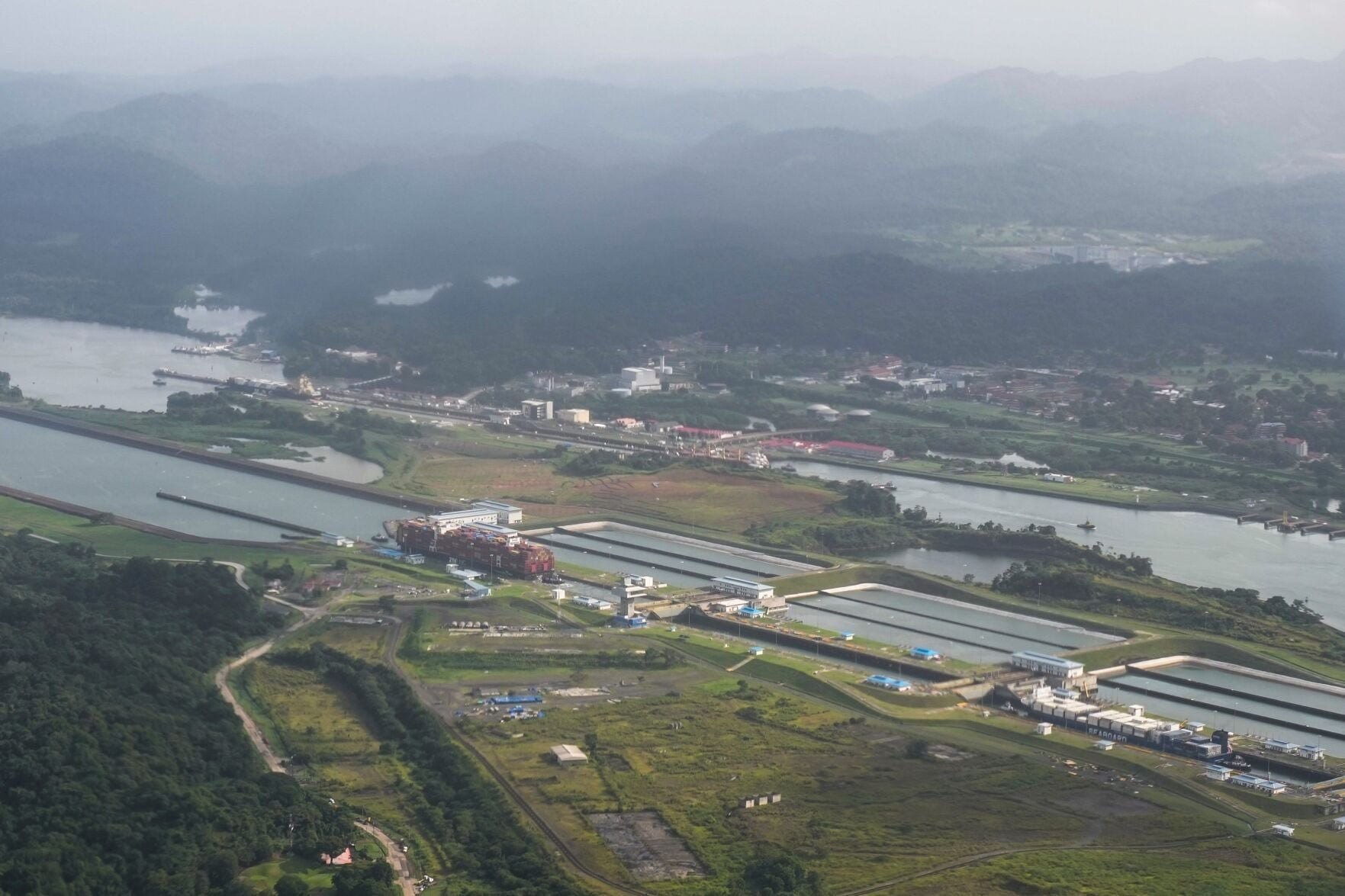
The canal is not a sea-level cut. Ships are lifted approximately 26–27 m from ocean level up to Gatun Lake, transit the lake across the continental divide, and are lowered back to the opposite ocean. The lift is performed in three steps on each side.
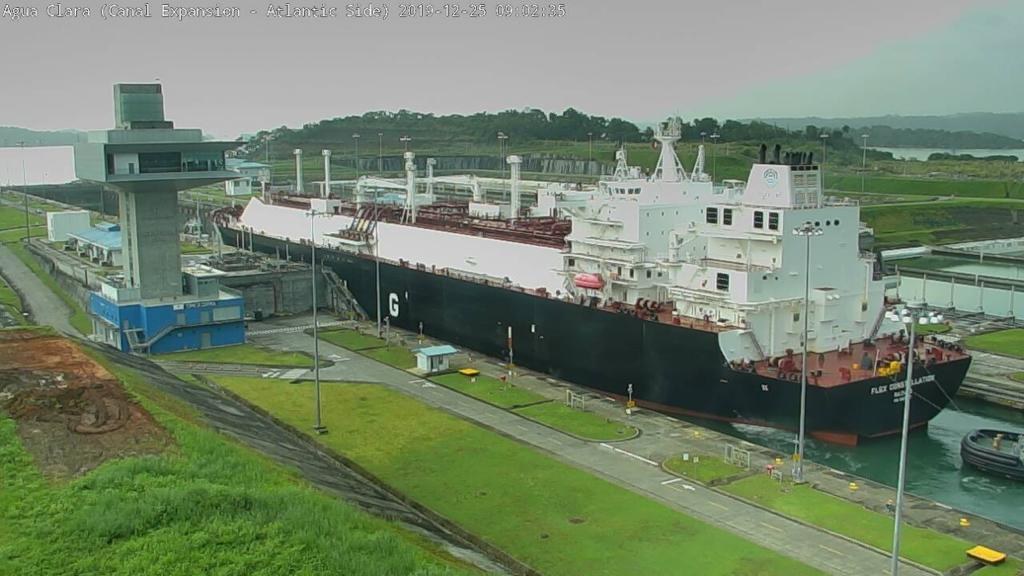
On the Atlantic side the Neopanamax locks are at Agua Clara; on the Pacific side they are at Cocolí. Each flight consists of three chambers. The original Panamax locks (Gatun on the Atlantic, Pedro Miguel and Miraflores on the Pacific) continue to operate in parallel for smaller ships. Gates on the new locks are rolling gates that retract into concrete side niches; the older locks use miter gates that swing like double doors. Water moves by gravity through large culverts under the chambers. No pumps are required for a normal lockage cycle.
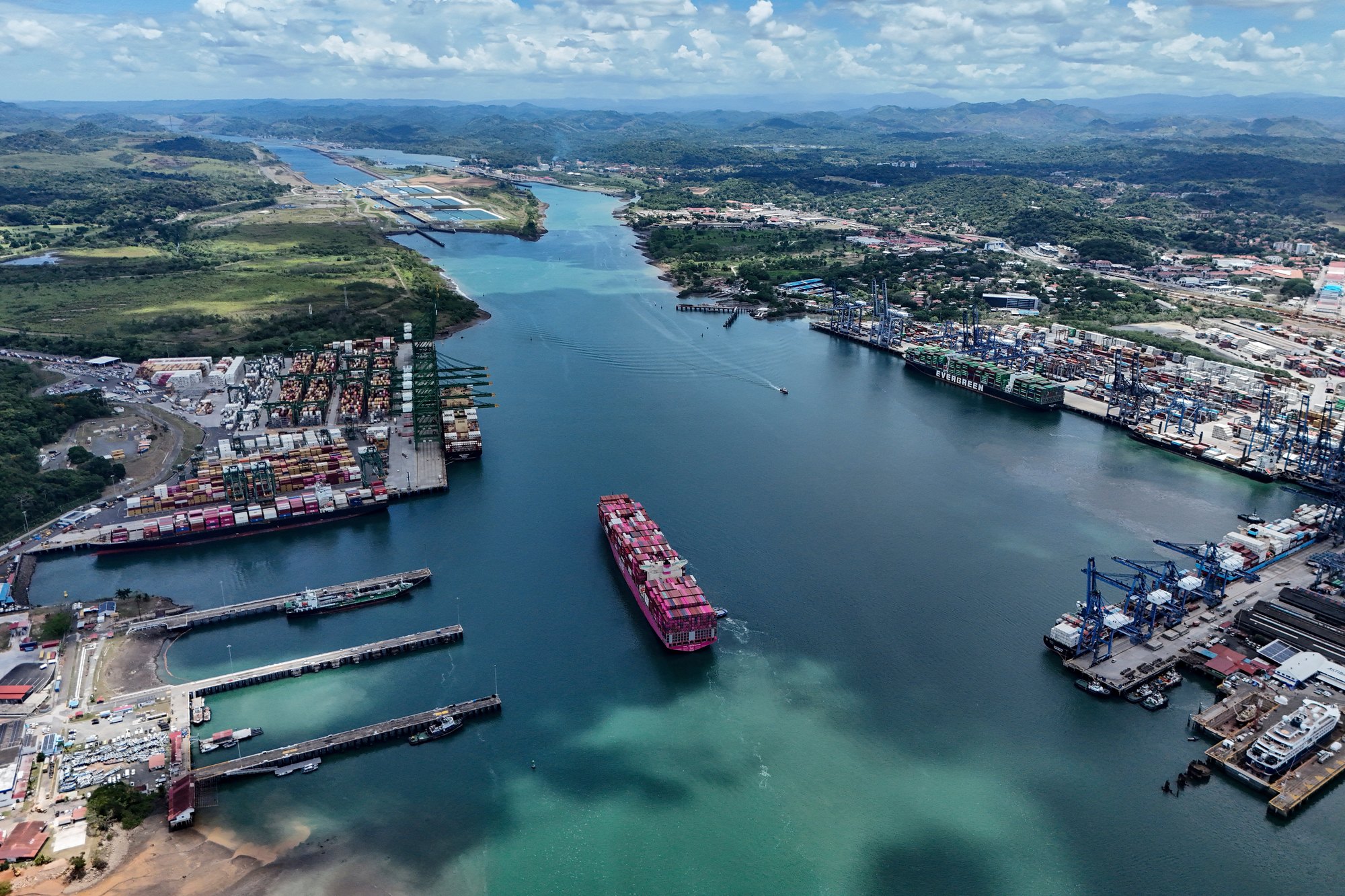
Gatun Lake, created by damming the Chagres River, is both the summit navigable channel and the reservoir that supplies lock water. Lake level is therefore the controlling variable for draft and for the number of ships that can transit in a day. Every transit that does not recycle water permanently exports lake water to the sea.
Why the lake must refill, and how the new locks save water
Because the locks work by filling and emptying with fresh water from Gatun Lake, every non-recycled lockage sends lake water to the ocean. In dry periods the lake level falls. When the level is too low the maximum authorised draft is reduced so that ships sit higher in the water and require less depth. Daily slot numbers are also cut so that the remaining water lasts longer.
A typical Panamax lockage without recycling uses on the order of 50 million gallons (roughly 190 million litres) of fresh water. The 2016 Neopanamax locks were designed with three water-saving basins beside each chamber. When a chamber is emptied, part of the water is first drained into the basins instead of straight to the sea. On the next fill those basins return their water to the chamber before lake water is used to top it up. The system can reuse roughly 60 % of the water that would otherwise be lost in a single chamber cycle. Net saving for a full Neopanamax transit is smaller than 60 % because the chambers themselves are much larger than the old Panamax chambers, but the basins still reduce the volume drawn from Gatun Lake per transit.
When rainfall and runoff remain low, even the water-saving basins cannot keep the lake full. Slot reductions and draft restrictions follow. The current advisory is the operational response to that arithmetic.
Established
- ACP Advisory A-29-2026, 20 August 2026: slot reductions from 4 Sept and 15 Sept; draft increases postponed (official).
- Rainfall 34 % and inflows 44 % below historical average for May–August (ACP).
- Canal remains open under reduced capacity.
- Neopanamax locks use three water-saving basins per chamber, designed to reuse a large fraction of lock water.
- Forecast centres describe the developing 2026–2027 El Niño as very strong to super, with high probability of persistence into early 2027.
Not established
- Exact additional cuts beyond the published tables.
- Duration of the current restriction regime.
- Peak intensity of the 2026–2027 El Niño beyond the current ensemble forecasts.
- Exact water volume per Neopanamax transit under current operating conditions.
Contact: desk@seavanta.com — tips, corrections, I was there.