
Energy · Emissions·26 Oct 2026·Australia · Uruguay · Argentina
Gorgon plumes and the cattle comparison
Carbon Mapper’s Tanager-1 satellite recorded methane plumes over Chevron’s Gorgon LNG plant on Barrow Island on five passes between November 2025 and 29 August 2026. The latest public observation showed an average rate of about 7.8 tonnes of methane an hour.
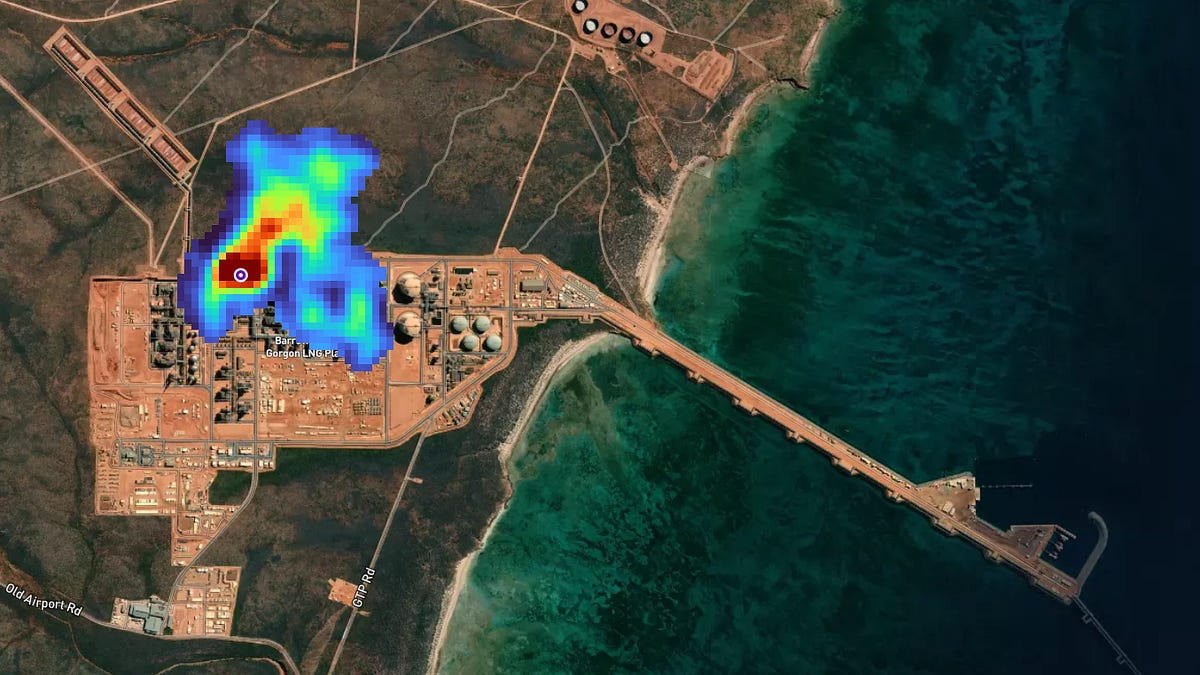
An earlier average of the five quantified releases was about 4.9 tonnes an hour. The United Nations International Methane Emissions Observatory issued an alert. Western Australia’s Department of Water and Environmental Regulation is investigating. Chevron said satellite monitoring has a wide range of uncertainty and that the company is engaging with the UN programme. The plumes appear to originate from or near the acid gas removal units.
Data Desk calculated that a 50 percent persistence rate at the 4.9-tonne average would equal roughly 16,000 tonnes of methane between late November 2025 and late August 2026. For the year ended June 2025 Chevron reported that the entire Gorgon facility emitted roughly 9,000 tonnes of methane under Australia’s Safeguard Mechanism. The two figures are not the same measurement.
The International Council on Clean Transportation measured real-world methane slip from 18 ships using low-pressure dual-fuel four-stroke engines. The average was 6.4 percent of fuel mass. FuelEU Maritime currently assumes 3.1 percent for the same engine class. The IMO assumes 3.5 percent. Slip is higher at low loads. High-pressure diesel-cycle engines show much lower slip.
Uruguay’s national inventory put livestock methane at 689 Gg of CH4 in 2020, of which 98 percent was enteric. That was about 90 percent of the country’s methane and about 53 percent of its total CO2-equivalent emissions that year. The bovine herd stands near 11.8 million head. An INIA paper using the GWP* metric found that a roughly stable herd over decades produces a small cumulative warming contribution under that metric. GWP100 treats every tonne of methane the same. GWP* does not for a flat emission rate.
Argentina’s beef sector emitted about 169 million tonnes CO2-equivalent in 2015 according to FAO figures, with enteric methane about 62 percent of that total. Absolute annual enteric methane from Argentine cattle is an order of magnitude larger than Uruguay’s and far larger than any single LNG plant’s reported methane.
A persistent plume at 5 tonnes an hour is large for one facility. A national cattle herd is larger in annual tonnes. The difference is the source. Methane that leaves an LNG plant or an LNG-fuelled engine is new carbon from a fossil reservoir. Methane from a stable cattle herd is part of a short-cycle biological loop. Regulations now count both. They do not weight them the same way.
Established
- Five Tanager-1 detections over Gorgon, rates reported by ABC and Data Desk.
- UNEP IMEO alert issued; WA DWER investigating; Chevron engaging and noting satellite uncertainty.
- ICCT FUMES average 6.4 percent slip for LPDF 4-stroke engines versus FuelEU 3.1 percent and IMO 3.5 percent defaults.
- Uruguay 2020 livestock CH4 of 689 Gg (98 percent enteric) and herd near 11.8 million.
- Argentina beef-sector 2015 total of about 169 Mt CO2e with enteric share about 62 percent (FAO).
Not established
- Exact annual methane mass from the AGRU vents (persistence assumption not confirmed).
- Whether the plumes have stopped.
- Independent verification of the INIA GWP* temperature contribution figure.
- Direct comparison of one plant’s methane to a national herd without the biogenic-versus-fossil distinction.
In the library & related
Contact: desk@seavanta.com — tips, corrections, I was there.